
 Loggerhead turtles have returned to Georgia’s beaches. Members of the Georgia Sea Turtle Cooperative found the state’s first loggerhead nest of 2008 last week on Blackbeard Island, signaling the start of nesting season for the federally threatened species.
2008 also marks the 20th anniversary of the Sea Turtle Cooperative, a milestone for sea turtle conservation. Coordinated by the Wildlife Resources Division of the Georgia Department of Natural Resources, the group of volunteers, researchers and biologists from various agencies
monitor turtle nesting on Georgia beaches.
Loggerhead nesting numbers vary widely from year to year. The 2007 total of 689 loggerhead nests, down from 1,400 in 2006, was considered a below-average nesting year. The 2006 nest totals were the third highest since comprehensive surveys began in 1989, with 1,419 nests found in 1999 and 1,504 nests in 2003. The annual average in Georgia since 1989 has been roughly 1,045 nests.
Adult female loggerheads come ashore to dig nests and lay eggs from May through September. Their vulnerable hatchlings scramble to the sea approximately 60 days later, swimming for the open ocean, where fewer predators lurk.
Loggerheads do not nest every year. Generally they return to lay eggs - about 120 per nest - every second or third year.
Listed as threatened under the federal Endangered Species Act, the loggerhead (Caretta caretta) is Georgia’s primary nesting sea turtle. Adults can grow to more than 300 pounds.
Threats to the survival of loggerheads include commercial fisheries, development of barrier islands, and nest depredation by coyotes, raccoons and feral hogs. Wildlife Resources and conservation groups have worked to address the fishery threat by enforcing regulations that
require shrimpers to use turtle excluder devices - grids that fit across the opening of shrimp trawls to keep turtles from entering the nets.
Sales of Georgia’s nongame wildlife vehicle license plates - the bald eagle/U.S. flag and the hummingbird - support conservation projects such as sea turtle restoration. Wildlife Resources’ Nongame Conservation Section does not receive state funds, depending instead on federal
grants, donations and fundraisers such as nongame tag sales and the Give Wildlife a Chance state income tax checkoff. Watch Georgia Outdoors: Seas Turtles or Georgia Outdoors: Georgia's Sea Creatures
Thursday, May 15, 2008
First Loggerhead Sea Turtle Nest Found


Emmy Nominations for Georgia Outdoors!
Two Georgia Outdoors episodes were singled out for Emmy Nominations is past Friday, May 9. The winners will be announced at a banquet on June 21. But you can watch the nominated shows right now!
 Georgia Outdoors:Suwannee Watershed for Television Programing Excellence Category: 31, Informational/Instructional
 Georgia Outdoors: Citizen Science for Television News and Program Specialty Excellence Category: 19DE, Health/Science Program
Wild Fact: Bream
 The group of freshwater fish called “bream” includes species such as bluegill, redbreast sunfish, and redear sunfish (also called shellcracker). Compared to other sportfish, bream are fairly easy to catch. All you need is a basic rod and reel with monofilament line, a bobber to hold the bait off the bottom and to signal bites, and a small hook. Live worms and crickets make good bait and are available at most convenience stores near lakes. Spring is a great time for bream fishing since they’re spawning. Rather than seeing bait as food, “bedding" fish often think your lure is a threat to their nest and aggressively strike it.
Visit this website to learn more about identifying fish.
Wednesday, May 14, 2008
National Bike-to-Work Week
May 12-16 is Bike-to-Work Week.
May 16 is Bike-to-Work Day.
The League of American Bicyclists (LAB) celebrates National Bike Month each year in May. It's a chance for people to consciously promote cycling and the many ways bicycling is such a fun and useful way to get around.
Need some ideas? Here are 50 ways to celebrate Bike Month.Also, download this pamphlet on the How's, Why's and Simple Pleasures of the Two-Wheeled Commute.
For information about events in your area the League of American Bicyclists .

Watch Georgia Outdoors: Biking.
Friday, May 2, 2008
Record the Ribbit this Sat, May 3
Leap into spring with your family and friends to celebrate FrogWatch 2008: Record the Ribbit. Participate in this one-day event to raise awareness about frogs and toads. Record the Ribbit is easy, free, and perfect for people of all ages.

Prepare by listening to calls and viewing photos of local species in your area, head outside on a nature walk, and then come back to share your findings online. Make sure to take a notepad with you to jot down your observations.
Record the Ribbit is a special event of Nature QuestSM FrogWatch USA™, National Wildlife Federation’s popular citizen-science amphibian monitoring program.

Tonight and This Weekend on Georgia Outdoors
Georgia Outdoors: Georgia's Marshes
Though Georgia's coastline is relatively short – only about 100 miles long – it holds one third of the salt marsh habitat on the east coast. From the freshwater rivers 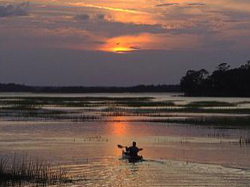 which feed the marsh into the muddy grassland of the marsh itself, we'll explore the incredible biological diversity of the salt marsh.one third of the salt marsh habitat on the east coast. From the freshwater rivers which feed the marsh, into the muddy grassland of the marsh itself, we’ll explore the incredible biological diversity of the salt marsh.
We start with a kayak trip down Cathead Creek, a tributary of the mighty Altamaha river which feeds the marshland of Macintosh County. From there, we visit the Sapelo Island National Estuarine Research Reserve for a tour of the marsh with a group of students. The salt marsh is also a great place for fishing, and we venture out to fish for red drum both at high tide and low tide.
Thursday, May 1, 2008
Wild Fact: Rose-breasted Grosbeaks
 After wintering as far south as Ecuador, Rose-breasted Grosbeaks are migrating to their breeding grounds in the Appalachians and northwestward into Canada. Slightly larger than their Cardinal cousins, these songbirds are strikingly beautiful. Males are jet black except for a raspberry triangle in the middle of their bright white chests. Females are much duller, streaked with brown but sporting white eyebrow lines. Both sexes have ivory cone-shaped bills, indicating a diet that includes seeds. You can help Rose-breasted Grosbeaks refuel during their journey north by offering sunflower or safflower seeds, preferably in platform feeders or tube feeders with trays ~ that way these large songbirds can perch comfortably while eating.
Photos (taken by Linda May, GA DNR-WRD) show Rose-breasted Grosbeaks eating safflower seeds from a Droll Yankee tube feeder with a tray. Cardinals and their relatives seem to particularly like safflower. An added benefit to offering safflower is that squirrels are not as attracted to this type of seed as they are other birdseeds.
WILD Facts is a new regular feature written by Linda May, a wildlife interpretive specialist with the Georgia DNR Wildlife Resources Division based at the Charlie Elliott Wildlife Center in Mansfield, Georgia.

 Posts
Posts


